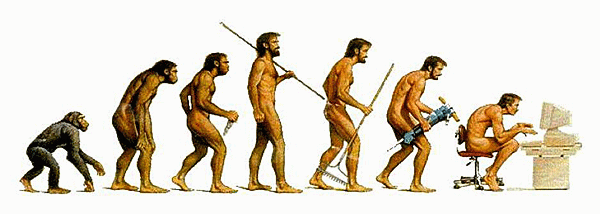
Friday, December 17, 2010

How To Make a Photography Slideshow

Hey guys! As my last digital literacy lab, I would like to explain how I made a slideshow for my photography final this semester, because it's super easy using Adobe Lightroom, an inexpensive, very simple replacement for photoshop.

1. Firstly, download the Adobe Lightroom 3 Trial. Or buy it. Whatevs.


2. Okay, now this program is pretty user friendly. It's got a nice interface as you can see. So check it out, then when your ready to make a slideshow, hit the button in the left column that says "Import..." then pick your files. If you click on the "Develop" button from the drop down menu at the top, you can do some basic color, hue, and saturation editing--nothing too fancy, there aren't any layers in this program (which is why I could never use this for illustration), but there is definitely enough to improve a photo.


 3. Now click on the "Slideshow" tab on the drop-down menu and you can make customized backgrounds, slide times, transitions, and title and end pages. It's pretty straightforward. If you want to add a song, find the box that looks like the one below, and select music from your music folders or what have you. When you're all done, hit play and you can see how it looks. When you're satisfied, press the Export Video button on the left hand corner. It will export as a handy dandy .mp4 . A really nice program.


Thursday, December 16, 2010

Final Reflective Post

Well, well, well. Digital Civilization has come to a close. So sad.


Like Dwight here, I'm gonna miss it. My favorite thing about Digiciv is that I believe it asked me to change my mentality. After the first evaluation, Dr. Zappala invited me to put my personal voice into my entries and into the class projects. Before then, I had been writing blog posts in a robotic fashion, failing to synchronize my semester goals with the class assignments. After the evaluation, I changed my pace and focus a bit.  I challenged myself to learn first, and then let the grades result as they should from application and work.


Monday, December 6, 2010

Making a Widget

Hello all! This blog post is all about making your own online widget. Widgets are very useful for connecting your blogs and other internet adventures together. For instance, I have this blog, but I also post regularly on two other blogs, so you can see the little widgets I have made on the right column for ididnotdrawthis.blogspot.com, my art blog and treesclaptheirhands.tumblr.com, my photography blog.

Since posting these widgets, I have had an increase in views for both blogs, so its a great way to get more traffic to your internet projects. Here's the resource I use: http://www.widgetbox.com. And here's how you do it:

Friday, December 3, 2010

Life 3.0 Illustration


First life is the best life. I hope this is the message that comes across when you come to the Digital Revolution Presentation on Thursday, December 9 at 7:00 pm - 9:00 pm. in 3108 of the JKB, and watch Morgan, Eric, Clint, Trevor, and I present our music video!

Thursday, December 2, 2010

Nominated Blogs!

Throughout this Digital Civilization class that I have been blogging for, there has been many entries among my classmates. Some of them have stood out to me, and I have nominated a few entries for their awesome content and connection. And the Nominee's are.....


Wednesday, December 1, 2010

My Internet Art Projects.

I added these links as afterthoughts on other blog entries, but I have realized how important they are to my internet identity. This post is dedicated to my art blogs.

deerforblog.jpg


 So I'm going to take advantage of Web 2.0, and explain some of my other internet projects. I tend to post a little slower on this blog compared to other bloggers, but I am an active internet user in other ways. So, Here are some of my other projects. I will also be adding widgets on this blog shortly, for quick links:

Thursday, November 18, 2010

Creating Art on Photoshop: A Basic Tutorial

So, for this post I am going to show the basics of how to create and post digital art on an art blog, using my Gulliver's Travels illustration. First of all, you'll probably want to use a fancy thing called a tablet. It's a kind of plasticky pad you draw on with a stylus like a pad of paper. The points on the pad correlate to pixels, so its like you are drawing straight onto the screen. A must have for any digital artist. It can connect via USB ports to the computer. Here's mine a Wacom Intuos 3:

intuos3.jpg


These can get pricey, so if you don't have one, go take your ID card to the media lab in the basement of the HFAC (provided you are a BYU student, of of course), and you can try one out for a few hours. For this tutorial I am using Adobe Photoshop CS4, but any of the recent photoshop versions will be great, this is a pretty simple tutorial.

Sunday, November 14, 2010

Production Photos

Hello! I don't think I ever formally announced this, but I am a part of a work in progress film for our Digital Civilization Final Project. That was the sole reason I left my comfortable bed on Saturday morning at 7 am to go out into the cold, moody Provo canyon. The waterfall was forming icicles! Okay, here's some awesome photos of our team at work:

Good morning, P-town.

Friday, November 12, 2010

Peer Evaluation - Trevor Cox


Trevor Cox’s blog is enjoyable to critique, based on its user friendly appearance. As I started evaluating it, it was clear to me that he has had experience with blogging. One of the things that stood out to me most about his interface was his to-the-point posts. They show great brevity, but they also say important things. I commend him on this, as I tend to take a much longer space to say something. 
Through his articles and frequent posts, it is very clear he is doing his readings. It is also clear that he, like I, is trying to find tidbits of certain subjects that really interest him. For instance, instead of recycling a wikipedia entry about Freud, he brings in a pop-culture reference to a TV character who was obsessed with Freud. This is a funny way of incorporating himself into his readings, and I appreciate that.

Self Evaluation: The Sequel

         Seeing as this is an experimental class with experimental expectations, I feel like my posts have been more meaningful this time around. Meeting with Dr. Zappala really helped me to direct my learning. His big three pieces of advice were that I should (1) use more historical data and that I should (2) incorporate illustrations into my blog and (3) use diigo more often to document my self-directed learning. 
As far as Historical Content goes, I have a few rules when it comes to learning something new from a class. I am a firm believer that I should be able to find something exciting or interesting in every topic. (Yes, that even means economics =) ). With that mindset, I have truly been able to see some cool sides to math and to the complex systems of our world. I have posted various blog entries where I try and think things out and I try to see things from my own angle. See the Alan Turing post for an example of this kind of historical post.
    

Wednesday, November 10, 2010

Economics for the Greater Good.

Its probably the Harry Potter nerd in me, but I often think of Dumbledore and the Ministry of Magic whenever I hear "For the Greater Good." To me, this saying always has communist connotations, so I'm always looking at it in a negative light. But that is not necessarily the best. Honestly, Marxism aside, isn't it a perfect ideal that we should all aim for? If everyone replaces their selfish ways with acts for the greater good, wouldn't we all be lifted up by eachother? 


c23-horcruxes.jpg


Saturday, November 6, 2010

Algorithms and Art


I was talking to a friend of mine the other day, discussing how there is this part of me that really is repelled by order and practicality and therefore...mathematics. It really has been my worst and most frustrating subject all through my educated years. However, there is this strange part of me that could kind of see a possible romantic side to mathematics..


 And this British mathmetician Alan Turig, was from my reading, a brilliant an innovative thinker. He was way beyond his years in the way he imagined computers and memory. Whenever mathematical geniuses like him are discussed, I am truly interested and a part of me is in incomprehensible awe.

Wednesday, November 3, 2010

Systems

We humans love order. Let’s face it, compared to the other animals in this world, we embrace it so fully. We hope for order in our schools, our churches, and our homes. Sure, some of us might be slobs in our rooms, but there is this human part of us that adores a clean room. 

It’s in our nature. It’s also in our nature to search for order in seemingly chaotic ideas and things.

I bring up this theme, because it's something that occurs to me as I read about this Sigmund Freud guy. I know a lot of his work was innovative and different. I know he probably had some truthful ideas, but I can’t help but think, so what? He divided human’s actions into life-centered or death-centered. Great. Now, what would a hypothetical patient seeking help with an addiction do with this information?

Sunday, October 24, 2010

The Quest for Truth


When you’re in the visual arts program at Brigham Young University, a theme of “being an artist who is a mormon” or being a “mormon artist” is often brought to the table. We often discuss the implications of what our mormon ideology brings to the table in the large contemporary art discussion happening around the world. 
As an illustration major and general appreciator of the arts, I have discovered an interesting juxtaposition of truth in this world: artistic truth and spiritual truth. To me, when these things are together, I am my mind is completely uplifted and inspired to create and to give something to society.

Tuesday, October 19, 2010

Science and God? Together?

I took an excellent biology class last year with Dr. Paul Evans, an archeologist and biology professor at BYU. His class was a colloquium-style, mainly based on discussion. We even had three weeks of class off because he went to Egypt to work on some of the tombs that the government of Egypt has hired BYU students to excavate and study.  
During his class we focused primarily on Evolution. At a religious school like BYU, evolution is approached with a Christian perspective and we are challenged to discover exactly what evolution is, how it is happening, and to find whether or not it is compatible with a belief in God. 
Dr. Evans testified that the two were not only compatible, but that they were both essential to each other. He exhorted his students to seek secular knowledge on the subject so that we could participate more in the contemporary discussion of the origin of species.


During the class, we also drew a parallel to the trial of Galileo Galilei. Galileo was charged with treason against the Catholic Church for his claim that the Sun was the center of the universe. This contradicted the interpretation of Joshua 10:13 by the Pope, stating that the “sun stood still.” The Pope dictated to the people that this was only possible by the former belief of Ptolemy, that the Earth was the center of the universe, and the sun stopped in its path around it. Galileo had the physical evidence in his telescope. He had the facts and the math right, and showed it to those who dared to look and challenge the Pope. But alas, the Holy Roman Catholic Church’s power was so fragile at the time and so it was “necessary” to convict Galileo of false teachings. 
With our approach to modern science, religious students and scholars must carefully search for truth. We must not allow either extreme of religion and science to sweep us away, but must look for the common ground between the two. Many a scientist believes the two are completely incompatible, but I know many students who are both scholarly and spiritual in their pursuits for knowledge.
In the world of Evolution, I believe that the proof is there and the patterns are apparent enough to accept many of Darwin’s theories as truth. I have my own theories of how God fits in to this spectrum, but to be honest, I don’t truly know how everything works out, nor does the practiced scientist. We don’t know if this universe is expanding or contracting. We don’t know where the mouth of the Orinoco river is. Neurology is one of the most obscure fields of medicine, because we have very little understanding of the human brain after millions of years. The many mysteries of this world should never be used as an excuse for remaining ignorant to modern, proven science. Likewise, our expanding knowledge should never be overestimated as alphaomega-esque understanding.

Gulliver's Travels Illustration

As a group, we decided on Sarah Willis' book club idea Gulliver's Travels. This satire reflected many great ideas of romanticism, including the ability to question the powers that be and to explore the natural world around us, which Lemuel Gulliver does in his many adventures. Since the most famous of Gulliver's scenes is when he is among the small people, I chose to illustrate a different "travel" of dear Gulliver.


Gulliver Speaking with his Houyhnhnms Master.
Click for larger version. Created with Photoshop.

In part four, Gulliver arrives in the land of the Houyhnhnms and the Yahoos. The Houyhnhnms are the masters and they resemble horses. The yahoos, who are humanlike, are the very dumb slaves to the Houyhnhnms. Gulliver is discovered and well liked by a Houyhnhnm, who becomes his master. He learns their language and begins to teach his master of England and of the affairs between different countries where he comes from. This is a scene of Gulliver explaining to the Houyhnhnm the politics of his hometown. I imagined his master to be quite wealthy and to have Yahoos servants adoring him at all times. This is not specifically described, but I felt it was a bit of artistic license I would like to take.

Useful Creativity

As we study Charles Babbage in class, I am struck by the foresight that this man must have had. The mind of an inventor is a special thing. It is one that both the artist and the scientist admire. It is a crossroad of utility and creativity.

There's a certain air of confidence you must have in your own ideas, a daring spirit that traverses the opinions of others. You must be daring enough and persistent enough to take your precious free time and use it for something else.

America's Inventor Magazine says that "the mind of an inventor is that of a curious child, always exploring the world around him. It is a world of wonder and wondering, asking what makes things work and why they are the way they are and do the things they do. It's a world of looking at things in a "different" way than people look at things. In the "real" world, the normal three dimensional world, people see the outside of objects -- things that have a defined shape or size, color, texture and weight -- but they always look at things as they are, not as what they can be or could become."

This seems to echo similarly with the world of the hacker, as Dr. Zappala explained him. He said that it is necessary to look at the world as a problem that needs to be solved.

Tuesday, October 12, 2010

Simplify, Simplify, Simplify (?)

I feel as if the intelligent members of this world always feel the need to "simplify." There's something about getting down to the elements of a system that is very gratifying. Many problems cannot be solved without understanding the underlying fundaments, so it is natural that simplification is often thought of as a cure-all.


"Walden" by Thoreau embodies this idea. "Every morning was a cheerful invitation to make my life of equal simplicity, and I may say innocence, with Nature herself," Thoreau states. Later he remarked, "Our life is frittered away with detail. Simplify. Simplify."


Ikea
Apple


Target


"Simplifying" has even been quite the mantra for products these days. Think about some of the most successful companies in the world. Ikea. Target. Apple. All of these have the appearance of streamlined simplicity in their products.


Notice how I worded "appearance." For, when does simplicity become a barrier to learning? Simple sayings can embody whole truths. "Love thy neighbor," "Meat is murder," "Do unto others as you would have them do unto you," "Liberty over equality." But those all must be applied in the some of the most complex manners to our complicated, diverse lives. After all, behind the simple appearance of companies like Apple and Target, there are complex hierarchies and systems made to generate profit. And as far as religion goes (which is quite far, it influences our lives and our perceptions so greatly), C.S. Lewis said quite profoundly,
"It is no good asking for a simple religion. After all, real things are not simple. They look simple, but they are not. The table I am sitting at looks simple: but ask a scientist to tell you what it is really made of--all about the atoms and how the light waves rebound from them and hit my eye and what they do to the optic nerve and what it does to my brain--and, of course, you find that what we call 'seeing a table' lands you in mysteries and complications which you can hardly get to the end of." (The Case for Christianity)


Monday, October 11, 2010

I kind of have a crush on...


This guy. 

John William Waterhouse. Figure painter extraordinaire.  Funny that we mentioned him in class. Everything I stand for in art is expressed by this beautiful figure painter:

-Strong feminine characters
-Storytelling (I'm an illustration major)
-Enchanting representations of our world
-An exciting mix of Realism and the Pre-Raphaelite movement. The Pre-Raphaelite movement was one that looked back at Michelangelo, Raphael, Da Vinci, and Religious and Mythical sources for their work.

Mermaid John William Waterhouse.jpg
"Mermaid" by J. W. Waterhouse


This stuff is some seriously beautiful work. I did a color and composition study of the mermaid below. Quite unfinished and really just a study, but voila:


Isaiah 53:2

"For he shall grow up before him as a tender plant, and as a root out of a dry ground: he has no form nor comeliness; and when we shall see him, there is no beauty that we should desire him."

Thursday, October 7, 2010

Book Club Ideas


1.  Onegin by Alexander Pushkin
One of my all time favorite books. Pushkin, 
Russian "Shakespeare" tells the tragic tale of 
love realized too late. It has this beautiful Russian
tragic spirit about it. It ain't your average feel-
good Austen book, but there's just as much depth to the 
characters and sympathy for their situations. And there's
a dramatic gun scene!


2. In Cold Blood by Truman Capote
What's up with the bloody murder stories?
I promise you, I am a happy person with a good life.
The reason I am so attracted to this story is due to its
intricate look at the "bad guys" and their thought 
process behind a murder of the innocent. They 
become machine like and almost inhuman, going 
through the horrible actions in an almost 
unattached way. This author spoke with the actual
 murderers of a Kansas family and had an "interesting"
relationship with one of them. The question of glorified 
truth and real truth comes to mind. How much of this 
story is coddled in the eye of the author? 


3. A Very Old Man with Enormous Wings by 
Gabriel Garcia Marquez
A wonderful choice due to the fact that
it is a short story and one could read it 
in a matter of twenty minutes or so.
In fact here is the link:
Marquez writes these thrillingly colorful
stories that mainly take place in South America. 
He mixes realism with fantasy to question our society
and his writing is quite lovely. One of my favorite authors.

Ever Seen This Before A Movie?


The media revolution seems to pose a threat to artists, some believe. 

I do not believe that is true. Let me say that again: As someone who is forming her career as an illustrator at this moment, I am more excited than ever about the career opportunites that lay ahead, due to technology and the open content we enjoy. Some may find me naive to believe that I will not be adversely effective. Think away. But I believe while there is so much wonderful art being used with creative common licensing, there is an even greater appreciation for classy advertising, for commissioned pieces, for good stories, for good ideas. And those kind of things come from illustrators and artists and graphic designers. The beauty of the invisible hand is that people will decide what they want to keep in the market. People, not dictators.

I would like to introduce a new form in which this is being done: 

Tumblr. 

It is a blogging site primarily used for the sharing of images.
Blogs used through this service often epitomize the term "visual essay." They are lovely, thoughtful, like a running television show
of stunningly beautiful photography and ideas. Some call it indulgent. Some call it a "hipster's paradise." But me, I find it a great way to collect cool visual ideas. 
Some of my personal favorites are the following:


“Everybody needs beauty as well as bread, places to play in and pray in where nature may heal and cheer and give strength to the body and soul.” -John Muir

Tuesday, October 5, 2010

Virtual Reality

For some reason, it occurs to me that I really dislike the fact that I sit in front of a screen for all of my classes' work. I wish hiking was more often an assignment than completing tasks on a virtual book or blog. I know, I need to get over it.This is just a fleeting rant. I like the internet and all that it has brought into my life, but sometimes it gets a little bit old, flipping through countless tabs on a virtual digital world represented on a thirteen inch screen.

Also, I feel like I never really introduced myself properly when I started this blog, so I'm going to do that right about now (Assigned blog Marxism entry is soon to come):

Name: Madeline K. Rupard. The K. stands for Kaye. Really exciting, I know.
Major: Illustration.
Height: I am 5' 10." That means that 60% of the U.S. population is shorter than me.
Heritage: I am of Swedish, Hungarian, German and British descent. I am a daughter of the American Revolution. And my awesome Hungarian grandpa has a mustache and looks like Stalin/Hitler/Saddam/Every dictator that existed.
Likes:  I run every day. Not competitively, not for any marathon, or anything like that. I just love doing it. I love hiking. I love birds and plants. I love mexican food dearly. And road trips. And the way the east coast smells during the fall. And I have a love/hate relationship with French.
Music: Fleet Foxes, The Smiths, Sufjan Stevens, Laura Veirs, Coldplay, Björk, Joanna Newsom, Radiohead, to name a few.
Movies: Fantastic Mr. Fox, Amelie, Encounters at the End of the World, The Secret Garden.
Lifestory: In a sentence, I was born in Provo, lived in Canada, grew up in D.C., and recently lived in Georgia.
Goal: To one day publish a meaningful novel and/or children's book. And to work for myself as an artist. To create 2-dimensional worlds and stories and characters. Maybe even direct a film. Who knows, right?

Thursday, September 30, 2010

Art and Democracy

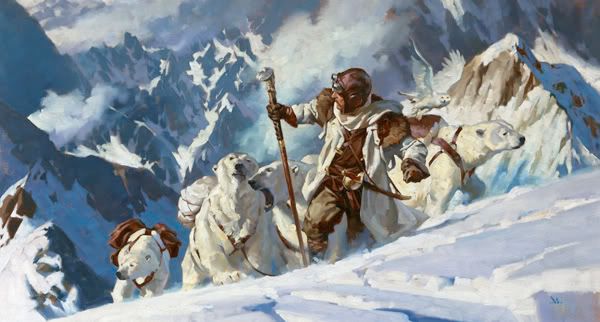
I'm feeling pretty artsy tonight. I just came from a seminar at the HFAC by Gregory Manchess, an incredible and quite famous illustrator that has been a guest lecturer today on our BYU campus. His work is adventurous, grandiose, and all about the human spirit. Here's one of my favorites:


With all this talk of democracy, it gets me thinking about how the government affects artists.
We live in a time and place in which democracy and communication are so vastly interlinked. In the art world, there couldn't be more freedom. But we didn't get there overnight. Not but a century ago, classical art was the only respected form and the art world was much more elitist and aristocratic than it is today. 

Art is a reflection on history, is it not? Yes, because the artists are always giving a bit of themselves into the pieces they show. Even if that bit of themselves is imprisoned by the status quo or limitation of speech...they are still showing that even if they are not displaying what they really want to express as an artist. For example, Leonarda Da Vinci, a beloved artist, was always commissioned to due religious grandiose art, but was quite the godless man himself. Yet his lovely works display the mantra and thought process of that time period, whether or not they were his interest.

Here's a brief blog entry about Art and Democracy: 

I found it to be relevant to our discussion and assignment.

Wednesday, September 29, 2010

Consume, Create, Connect: A Midterm Reflection

CONSUME: I feel as if most of my time was spent here. I mean we attended lectures, But I think that’s supposed to be the way it is. Think about how much information the average student gets at BYU, and how much information they actually put out. I feel as long as our minds are constantly going through that healthy process of sifting through ideas, the consumption of knowledge is a good thing.

-Browsing Blogs: I’m an illustration major, and one of my favorite past times already is checking out the french illustration blogs, where young artists are putting out some incredible stuff. However, my knowledge of non-art blogs is significantly smaller, and having teachers, classmates, and diigo to help us find some of those was really neat. Some of my favorites since this class started: 
http://curiouscapitalist.blogs.time.com/ - good for catching up with the US’s economy.
http://journal.davidbyrne.com/ - Talking Head singer David Byrne’s travel blog. Extremely cool and just really neat posts.
http://digitalcivilization.blogspot.com - I hate to sound like a sycophant, but this truly was a great source for our themes.
And many more.
-Google Reader: The fact that my whole class was automatically put under a folder without me having to organize things was awesome. Learning how to use this and to look up key topics quickly with the search bar has been enlightening.
-Printmaking: I especially connected to the historical content about Martin Luther. He was an inspiring leader and such a voice of reason in a time of so much religious oppression. It also helps that I’m learning all about printmaking right now, so I had a great time being very involved in this process and posting about it.
CREATE: To create is my purpose, my passion. I love the power of creating visual imagery more than anything else, and I have been putting these creations on my illustration blog for sometime already, so there was definitely some things I had background on already. However, this class had me look at different ways of creating meaningful media and blog posts.

-Embedding videos: I didn’t know how to do this before, so having a class where I wanted to make my assignments more interesting necessitated that I look it up and know how to do this once and for all.
-Garage Band: With my new mac, I know there are many tools and systems that if I simply was acquainted with, I could try some cool things. David Potter was one of my partners for the group activities, and he taught me how to use Apple’s Garage Band audio recording system. I successfully learned how to create track and to use the instruments on garage band! It was pretty streamlined and simple, but I wouldn’t have taken the time to learn it without this tutorial!
-Also, I have created and scanned in some of my own illustration work to show students and have created topics relevant to them.
CONNECT:

-Posting: The largest part of my time was spent consuming and creating, but only because those steps were necessary to get a good blog entry out there. I tend to like looser blog posts, than ones that stick firmly with the subject, so I’m glad that Dr. Zappala and Dr. Burton encouraged this. I would attend lectures, write notes, and brainstorm ideas by looking through our class websites and looking through some of the blogs I knew of. I always decided on a post that I had very real interest. For example, I am taking an intaglio printmaking class, so I am creating
-Diigo: I know this part of the learning might seem to fit under connect, but I feel as if this is a good create system for me. I can create these links and put my own systems. I have added a few of these links relating to our class and just for the heck of it as well. I will even continue to use Diigo for my own personal use after this class. 
-Comments: I received some good comments and followed up with them in conversation, which helped me feel as if I was integrating myself more into the digital blogging world, and understanding the very real connections and growth of knowledge that can happen here. Students have been making some great comments, recommending sites or prompting new ideas for me.
I know this isn’t part of the prompt, but I’d like to think about my future expectations for the class. I feel like this first section of the class was a bit of testing the water. The class expectations were defined in some ways, but in some ways looser, so I think this time around I will have a little bit more of an idea of what I should be looking for and boomarking to, posting about, etc. I really do believe that I can incorporate my life more often and make this blog entry more of a few times a week thing rather than just every time the assignment is due.I am taking a creative writing class, so I plan to post some of my poems on this blog, and I have learned how to write more effectively in that class, and hope to carry it on to Tame Sequels!

Something from Nothing

Everyone's giving out free stuff on the internet these days. Search Engines, Music, Books, Apps, you name it, it's free.


So....if everyone's giving out free goods, does that mean that people will stop earning money and our economy will suffer? Me? I believe that our economy will definitely change, and certain industries will change radically in the way they earn money, but I believe that people will just find other sources of income. I predict that the main source of income will become advertising in this new era. We are going to find industries related to web-based advertising are the strongest in the burst of this new technological based work era.


For example, I have a family member who works for a company that boosts the profiles of businesses on the internet. How does the company do this, you might ask? By making blogs that receive hits on google and putting links to the company on those blogs.
Here's her blog as an example:


http://minba.wordpress.com/


I personally believe that the economy will be fine. People will only spend time on free things if they have motivation to do so. If the economy takes a drop and people are worried about their jobs, then free software will decrease as much as necessary. Laissez-faire. As long as there is a decent balance between supply and demand, and people are still producing the kinds of things people want to buy/use, we cannot deny the technological progress, the free software. We are more likely to cripple ourselves from lack of progression than from too much of a good thing, in my opinion. I do not wish to oversimplify this, but I do know that people who work hard and come up with good, innovative products will often, if not always, find rewards.

Tuesday, September 28, 2010

Coloring Art on Photoshop.

Ever wonder how ads and illustrations have those cool graphicky solid colors in them?
Meet photoshop.


I recently posted a piece on my illustration blog called "monkey and cat":


This piece is simple in appearance. Its coloring process was fairly elemental as an illustrator, yet to achieve this screenprint color effect, I have had to understand the fundaments of photoshop. Here is a screenshot of the image in photoshop. Note that there are a good amount of layers that are present in the sidebar (For those inexperience with Photoshop, they are the little thin rows on the right).


Here is a basic step-by-step of what I had to do to accomplish this:

1. I drew the traditional ink lineart on paper with a micron pen.
2. I scanned in the image using Epson Photoscanner.
3. I opened up the file in photoshop, flipped it, cropped it, and edited it to get the lines crisp and ready for color.
4. I cut the black lineart out against the white background, and pasted it onto a transparent layer (Think of your teacher's old overhead sheets. Its like that.)
5. I colored a transparent layer underneath and set it under the lineart, so that the lines aren't covered with digital paint.
6. I adjusted the hue and saturation to meet my standards.
7. I messed with settings and layers and saved the file as a .jpg.

Voila! Monkey and Cat. (It's technically a baboon.)

GLOSSARY-

Layers- Layers in photoshop are like transparencies stacked one on top of one another. Each layer can have different images and effects. When the layers are stacked, the images appear as if they are all a single image.

Tuesday, September 21, 2010

Algorithms of Thought.


Wow, indeed, Homer. Wow, indeed.

How small we are. And we are surprised when things happen that prove our latest and greatest theories false. Those meddling Galileo and Darwin sorts are always messing things up! Time, Metabolism, Evolution, Ptolemaic Theory, These are all words conveying systems people use to try and harness the way this world really works and put it into a place that he can control and manipulate for his desires. "Nature, to be commanded, must be obeyed." We are incredibly complex computers--with insight of our existence. We know who we are. We, generally know what we want--happiness. Through our experiences and minds we decide how we are going to find happiness. Not all of us are successful. But we are all self-interested, unlike the modern computers we know today.

Even my proclaiming things to you is a self-interested act. The "theater" idol comes onto the stage, (NPI) I can only hope to find that my ideas receive some sort of recognition of truth, and that I am thought of in a higher manner by my teachers and fellow bloggers. Every human being does what they do for self worth--whether it is helping others or being a ruthless dictator, self interest and bias is at hand. Let it be noted that "self-interest" and "selfishness" are often different things.

Do we see some sort of gap between human and computer knowledge? My theory is that there is some sort of way of creating life that we will always continue to reach for in this world, but will never achieve. Computers are not at the bottom of this chain, because like we have discussed in class, search engines have the capability of gathering data and completing work that would take our human minds' years. But there is some sort of lower world we created in computers, one that can accomplish many great things, but will never truly emulate the complexities of the human brain.

Thursday, September 16, 2010

Google is Watching You

I feel I should bring up the question again that I had today in class. "Will my Xanga blog posts from middle school be read a hundred years from now or will they be obselete?" Reworded into a bigger question, it would sound like,
"Can the internet be considered a place to store long-term information?" 

As we discussed earlier, this question is up in the air. There is something so solid and real about printed material. Things in the virtual world may not be "recaptured" after many years and loss of bandwidth or whatever (I am no expertise or even amateur in the world of computer science, so this "bandwidth" idea may be completely irrevelant)


And can we bring in the whole "Nationalism, Empire, and Monarchy" theme to this? I submit that we can:


If Google, Inc., the number one search engine that is used, has access to all of this information about our lives, are we already being forced into an open government deal?


Google-watch.org says, "At another level, it's a struggle over who will have the predominant influence over the massive amounts of user data that Google collects. In the past, discussions about privacy issues and the web have been about consumer protection. That continues to be of interest, but since 9/11 there is a new threat to privacy -- the federal government. Google has not shown any inclination to declare for the rights of its users across the globe, as opposed to the rights of the spies in Washington who would love to have access to Google's user data."


To tie these two things together, I think that as a nation, and even as a world, there has to be some sort of agreement made regarding huge international internet based indexers like Google, and their powers in the affairs of human's rights to privacy. At the same time there has to be some sort of way of knowing where our information is stored, and for how long it will be available on the internet before we need to erase it. 


Another concern that I will raise is this:
What if Google's owners takes advantage of its situation and starts making threats to erase the data of those who get in there way?


Does anyone else see this as a potential problem? Or am I missing some major point that makes this a benign threat? Perhaps yahoo and the other search engine competition could keep everything in check? Give me your thoughts!

Monday, September 13, 2010

N-three-P

 That's what Michael Scott called the ever popular and widespread music format of the mp3 on the hit show The Office. He was a little digitally illiterate.

I just recently was in the multimedia lab of the library, learning a basic tutorial of garage band via fellow classmate David Potter. This was useful to me, as I recently switched to a mac from windows and I am eager to learn all of its creative tools. I am an illustration major, so I don't use audio tools quite as often as photoshop, but I do enjoy creating music as a hobby (I've always fiddled around with the piano and violin. When I say fiddled, I mean I don't read music at all.)

As an illustration major, I have learned to apply my skills through the online use of photoshop. Therefore, It's only natural in our technological age, that there is a digital counterpart to traditional music. I learned that garage band functions in ways somewhat similar to photoshop: Layers are a main tool, and you can save the file in different forms (AAP or MP3). When I first was experimenting with my new macbook, I tried to open up garage band as someone with no experience, and found myself a little confused. David explained how to use the system's keyboard even if you don't own a keyboard to plug-in, to use the wide array of instruments on the program.You can even plug in instruments and make vocal recordings using the program.

Using the vocal recording option and layers on Garage Band.
 To tie this in with our theme of protestant reformation, I think we can look at the recent history of music within the last few decades. We discussed this a bit in class, but the age of music sharing has been here for a solid decade now, and in a way, the widespread music can be compared to the widespread use of the Bible with Martin Luther's efforts. Maybe Shawn Fannin, creator of Napster, is like music's Martin Luther. I know religion and music are a bit different (Although, to some people they are synonymous), but I vaguely remember my dad, a bona fide music junkie, so excited to download one single song in 10 minutes. Now a days where we have torrents and sites in which we can upload music (youtube, beemp3, imeem, myspace music, etc), everyone is able to access their favorite artists and be in the "know" of what is cool just by clicking on a link or a play button that gives us the music in seconds. 

Cool Stuff. And if I were really into Garage band, its nice to know that I have the option of creating music via layers and recordings and keyboards on the program, and then exporting it as an .mp3 on my hard drive, and then uploading it to myspace and potentially becoming the new Justin Bieber. I'd be living the dream...

Thursday, September 9, 2010

Intaglio Printmaking

Fancy that printmaking is the theme.
This semester, my "indulgent" class is an elective called "Intaglio" printmaking.
This is something that I have had real interest in for a while. It is a sort of printmaking that has been used for ages. Among some of the famous intaglio printmakers:

-Albrecht Durer
-Rembrandt
-John Taylor
-Daniel Hopfer

The process is quite difficult and lengthy.

1.You must first take a copper plate and degrease it of all human oils.
2.You must cover it with a solvent of beeswax
3.You must carve an image into the beeswax.
4. You must place the piece into acid for about an hour, depending on the piece.
5. You must scrape off the beeswax and apply ink.
6. You must use an expensive printing press that can press all that ink into the paper.

So why am I doing this? Why do I choose this process which easily takes double the hours of using photoshop?

Because its cool. And different. And something to discover.

Here is me, excited about my first beeswax carving:


Here is my first amateur print (of birds, an obsession I will post about at a later time):


Monday, September 6, 2010

"Never badmouth synergy!"

One of my favorite teachers at Brigham Young University, illustrator Robert Barrett said something quite profound once during a class, 


"Those who really live life leave the stuff that is art."


I remember that it hit a real note with me and I have always kept that quote in mind when deciding how to use my time. Cicero had quite the critique from Petrarch. But I think the things that were said were very interesting coming from a humanist. I would like to think that latter-day saints strive to be humanists. I mean who doesn't want progression and education in Zion? But to be successful in being a humanist, well, it doesn't have so much to do with sheer hard work as much as it has to do with the basic ability we have develop to balance our lifes--and maybe "synergize" (Jack Donaghy would be so proud--30 rock fans please stand up?) those two different parts of our lives together to set examples for others.


In the illustration world, there is the well-revered Norman Rockwell, of whom I'm sure most non-art majors have heard of in their american history classes or something. This guy was ridiculously talented. His work had humor, charm, depth, technical mastery. I just saw an art exhibit with a bunch of his work in D.C. sponsored by George Lucas and Steven Spielberg, and these paintings are absolutely beautiful in person.


"School Teacher" - One of the lovely heart-warming pieces I saw in D.C.
His personal life? Well according to The Berkshire Eagle's "Portrait of Norman Rockwell",  
"Married three times, he was a caring but distant husband and father who spent years in therapy dealing with loneliness and depression....[He] painted happiness, but didn't live it."


A link to the article: A portait of Norman Rockwell


Would Rockwell have been as great as he was had he taken more family time to develop those domestic relationships?


The question is--does there have to be a real strain on our personal life in order for us to change the world? I don't believe so. Can we use technology such as youtube and blogs to make it easier for us to reach "the world" and still maintain a good family life?
To me, it rings true that the two can and should be balanced for us to become someone who really makes  a solid impact on the world and on the people in our lives. (Technology or not)

"What, pray, does it profit a man to teach others, and to be prating always about virtue, in high-sounding words, if he fails to give heed to his own instructions?" -Petrarch


I really hope no one writes a posthumous letter like that to me.

Wednesday, September 1, 2010

The Naming of Things

Hello! Welcome to my blog for the Honors Seminar Class: Survey of Digital Technology. 

My name is Madeline, I am an illustration major and french minor. I love foxes, indian food, studying peoples' faces, running, Joanna Newsom, creative writing, and all things lovely. I actually have another regular art blog, if you ever want to check it out. I post illustrative work and amateur photography on there about once a week. 

http://ididnotdrawthis.blogspot.com


I'm gonna be honest, I just kind of signed up for this class because it looked mildly interesting and it fit my schedule like a glove. As I am setting up my blog and everything, I am getting more enthusiastic about it. It seems like there are a lot of ways to be creative with blog posts.

Okay, this isn't a real "technological" post, but my blog looked so empty, so I thought I'd explain the name. Geez, I wish it was really interesting, but its not. I had to order books off of Amazon and there's this way of paying for things on amazon these days by entering a "PayPhrase." There's a random word generator and "tame sequels" was one of the options. (No, I didn't take it, so don't try and buy your textbooks with it, silly.) For some reason, I just loved the way that sounded. It had a poetic air about it and wrote it down in my journal instantly. It just rolls of the tongue nicely, "tame sequels." Plus, this is a sequel blog. So, it fit. 


Just so I can make this a legit post, here's a wall street journal article that talks about the new "PayPhrase" option on Amazon: 

    Here's a good quote, "Although there are seemingly infinite potential combinations, the problem might be that we humans just aren’t sufficiently creative. Amazon automatically generates some inadvertently hilarious suggestions for people when they sign up for a PayPhrase. (For us, Amazon has suggested “Ingrained Abhorrence,” “Enthusiastic Disdain” and “Turn Down Oven.”) Williams said the suggestions aren’t unique to a specific person, and come from Amazon’s efforts to scour tons of books for popular phrases."


Also, blogger is having a hard time listening to my formatting rules, so sorry if this is all spaced a little weird.