Sunday, October 24, 2010

The Quest for Truth


When you’re in the visual arts program at Brigham Young University, a theme of “being an artist who is a mormon” or being a “mormon artist” is often brought to the table. We often discuss the implications of what our mormon ideology brings to the table in the large contemporary art discussion happening around the world. 
As an illustration major and general appreciator of the arts, I have discovered an interesting juxtaposition of truth in this world: artistic truth and spiritual truth. To me, when these things are together, I am my mind is completely uplifted and inspired to create and to give something to society.

Tuesday, October 19, 2010

Science and God? Together?

I took an excellent biology class last year with Dr. Paul Evans, an archeologist and biology professor at BYU. His class was a colloquium-style, mainly based on discussion. We even had three weeks of class off because he went to Egypt to work on some of the tombs that the government of Egypt has hired BYU students to excavate and study.  
During his class we focused primarily on Evolution. At a religious school like BYU, evolution is approached with a Christian perspective and we are challenged to discover exactly what evolution is, how it is happening, and to find whether or not it is compatible with a belief in God. 
Dr. Evans testified that the two were not only compatible, but that they were both essential to each other. He exhorted his students to seek secular knowledge on the subject so that we could participate more in the contemporary discussion of the origin of species.


During the class, we also drew a parallel to the trial of Galileo Galilei. Galileo was charged with treason against the Catholic Church for his claim that the Sun was the center of the universe. This contradicted the interpretation of Joshua 10:13 by the Pope, stating that the “sun stood still.” The Pope dictated to the people that this was only possible by the former belief of Ptolemy, that the Earth was the center of the universe, and the sun stopped in its path around it. Galileo had the physical evidence in his telescope. He had the facts and the math right, and showed it to those who dared to look and challenge the Pope. But alas, the Holy Roman Catholic Church’s power was so fragile at the time and so it was “necessary” to convict Galileo of false teachings. 
With our approach to modern science, religious students and scholars must carefully search for truth. We must not allow either extreme of religion and science to sweep us away, but must look for the common ground between the two. Many a scientist believes the two are completely incompatible, but I know many students who are both scholarly and spiritual in their pursuits for knowledge.
In the world of Evolution, I believe that the proof is there and the patterns are apparent enough to accept many of Darwin’s theories as truth. I have my own theories of how God fits in to this spectrum, but to be honest, I don’t truly know how everything works out, nor does the practiced scientist. We don’t know if this universe is expanding or contracting. We don’t know where the mouth of the Orinoco river is. Neurology is one of the most obscure fields of medicine, because we have very little understanding of the human brain after millions of years. The many mysteries of this world should never be used as an excuse for remaining ignorant to modern, proven science. Likewise, our expanding knowledge should never be overestimated as alphaomega-esque understanding.

Gulliver's Travels Illustration

As a group, we decided on Sarah Willis' book club idea Gulliver's Travels. This satire reflected many great ideas of romanticism, including the ability to question the powers that be and to explore the natural world around us, which Lemuel Gulliver does in his many adventures. Since the most famous of Gulliver's scenes is when he is among the small people, I chose to illustrate a different "travel" of dear Gulliver.


Gulliver Speaking with his Houyhnhnms Master.
Click for larger version. Created with Photoshop.

In part four, Gulliver arrives in the land of the Houyhnhnms and the Yahoos. The Houyhnhnms are the masters and they resemble horses. The yahoos, who are humanlike, are the very dumb slaves to the Houyhnhnms. Gulliver is discovered and well liked by a Houyhnhnm, who becomes his master. He learns their language and begins to teach his master of England and of the affairs between different countries where he comes from. This is a scene of Gulliver explaining to the Houyhnhnm the politics of his hometown. I imagined his master to be quite wealthy and to have Yahoos servants adoring him at all times. This is not specifically described, but I felt it was a bit of artistic license I would like to take.

Useful Creativity

As we study Charles Babbage in class, I am struck by the foresight that this man must have had. The mind of an inventor is a special thing. It is one that both the artist and the scientist admire. It is a crossroad of utility and creativity.

There's a certain air of confidence you must have in your own ideas, a daring spirit that traverses the opinions of others. You must be daring enough and persistent enough to take your precious free time and use it for something else.

America's Inventor Magazine says that "the mind of an inventor is that of a curious child, always exploring the world around him. It is a world of wonder and wondering, asking what makes things work and why they are the way they are and do the things they do. It's a world of looking at things in a "different" way than people look at things. In the "real" world, the normal three dimensional world, people see the outside of objects -- things that have a defined shape or size, color, texture and weight -- but they always look at things as they are, not as what they can be or could become."

This seems to echo similarly with the world of the hacker, as Dr. Zappala explained him. He said that it is necessary to look at the world as a problem that needs to be solved.

Tuesday, October 12, 2010

Simplify, Simplify, Simplify (?)

I feel as if the intelligent members of this world always feel the need to "simplify." There's something about getting down to the elements of a system that is very gratifying. Many problems cannot be solved without understanding the underlying fundaments, so it is natural that simplification is often thought of as a cure-all.


"Walden" by Thoreau embodies this idea. "Every morning was a cheerful invitation to make my life of equal simplicity, and I may say innocence, with Nature herself," Thoreau states. Later he remarked, "Our life is frittered away with detail. Simplify. Simplify."


Ikea
Apple


Target


"Simplifying" has even been quite the mantra for products these days. Think about some of the most successful companies in the world. Ikea. Target. Apple. All of these have the appearance of streamlined simplicity in their products.


Notice how I worded "appearance." For, when does simplicity become a barrier to learning? Simple sayings can embody whole truths. "Love thy neighbor," "Meat is murder," "Do unto others as you would have them do unto you," "Liberty over equality." But those all must be applied in the some of the most complex manners to our complicated, diverse lives. After all, behind the simple appearance of companies like Apple and Target, there are complex hierarchies and systems made to generate profit. And as far as religion goes (which is quite far, it influences our lives and our perceptions so greatly), C.S. Lewis said quite profoundly,
"It is no good asking for a simple religion. After all, real things are not simple. They look simple, but they are not. The table I am sitting at looks simple: but ask a scientist to tell you what it is really made of--all about the atoms and how the light waves rebound from them and hit my eye and what they do to the optic nerve and what it does to my brain--and, of course, you find that what we call 'seeing a table' lands you in mysteries and complications which you can hardly get to the end of." (The Case for Christianity)


Monday, October 11, 2010

I kind of have a crush on...


This guy. 

John William Waterhouse. Figure painter extraordinaire.  Funny that we mentioned him in class. Everything I stand for in art is expressed by this beautiful figure painter:

-Strong feminine characters
-Storytelling (I'm an illustration major)
-Enchanting representations of our world
-An exciting mix of Realism and the Pre-Raphaelite movement. The Pre-Raphaelite movement was one that looked back at Michelangelo, Raphael, Da Vinci, and Religious and Mythical sources for their work.

Mermaid John William Waterhouse.jpg
"Mermaid" by J. W. Waterhouse


This stuff is some seriously beautiful work. I did a color and composition study of the mermaid below. Quite unfinished and really just a study, but voila:


Isaiah 53:2

"For he shall grow up before him as a tender plant, and as a root out of a dry ground: he has no form nor comeliness; and when we shall see him, there is no beauty that we should desire him."

Thursday, October 7, 2010

Book Club Ideas


1.  Onegin by Alexander Pushkin
One of my all time favorite books. Pushkin, 
Russian "Shakespeare" tells the tragic tale of 
love realized too late. It has this beautiful Russian
tragic spirit about it. It ain't your average feel-
good Austen book, but there's just as much depth to the 
characters and sympathy for their situations. And there's
a dramatic gun scene!


2. In Cold Blood by Truman Capote
What's up with the bloody murder stories?
I promise you, I am a happy person with a good life.
The reason I am so attracted to this story is due to its
intricate look at the "bad guys" and their thought 
process behind a murder of the innocent. They 
become machine like and almost inhuman, going 
through the horrible actions in an almost 
unattached way. This author spoke with the actual
 murderers of a Kansas family and had an "interesting"
relationship with one of them. The question of glorified 
truth and real truth comes to mind. How much of this 
story is coddled in the eye of the author? 


3. A Very Old Man with Enormous Wings by 
Gabriel Garcia Marquez
A wonderful choice due to the fact that
it is a short story and one could read it 
in a matter of twenty minutes or so.
In fact here is the link:
Marquez writes these thrillingly colorful
stories that mainly take place in South America. 
He mixes realism with fantasy to question our society
and his writing is quite lovely. One of my favorite authors.

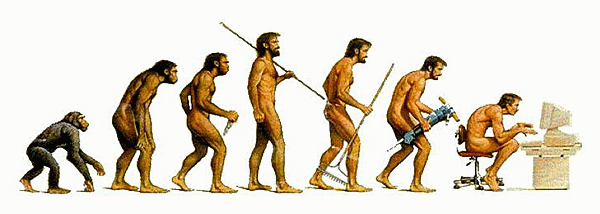
Ever Seen This Before A Movie?


The media revolution seems to pose a threat to artists, some believe. 

I do not believe that is true. Let me say that again: As someone who is forming her career as an illustrator at this moment, I am more excited than ever about the career opportunites that lay ahead, due to technology and the open content we enjoy. Some may find me naive to believe that I will not be adversely effective. Think away. But I believe while there is so much wonderful art being used with creative common licensing, there is an even greater appreciation for classy advertising, for commissioned pieces, for good stories, for good ideas. And those kind of things come from illustrators and artists and graphic designers. The beauty of the invisible hand is that people will decide what they want to keep in the market. People, not dictators.

I would like to introduce a new form in which this is being done: 

Tumblr. 

It is a blogging site primarily used for the sharing of images.
Blogs used through this service often epitomize the term "visual essay." They are lovely, thoughtful, like a running television show
of stunningly beautiful photography and ideas. Some call it indulgent. Some call it a "hipster's paradise." But me, I find it a great way to collect cool visual ideas. 
Some of my personal favorites are the following:


“Everybody needs beauty as well as bread, places to play in and pray in where nature may heal and cheer and give strength to the body and soul.” -John Muir

Tuesday, October 5, 2010

Virtual Reality

For some reason, it occurs to me that I really dislike the fact that I sit in front of a screen for all of my classes' work. I wish hiking was more often an assignment than completing tasks on a virtual book or blog. I know, I need to get over it.This is just a fleeting rant. I like the internet and all that it has brought into my life, but sometimes it gets a little bit old, flipping through countless tabs on a virtual digital world represented on a thirteen inch screen.

Also, I feel like I never really introduced myself properly when I started this blog, so I'm going to do that right about now (Assigned blog Marxism entry is soon to come):

Name: Madeline K. Rupard. The K. stands for Kaye. Really exciting, I know.
Major: Illustration.
Height: I am 5' 10." That means that 60% of the U.S. population is shorter than me.
Heritage: I am of Swedish, Hungarian, German and British descent. I am a daughter of the American Revolution. And my awesome Hungarian grandpa has a mustache and looks like Stalin/Hitler/Saddam/Every dictator that existed.
Likes:  I run every day. Not competitively, not for any marathon, or anything like that. I just love doing it. I love hiking. I love birds and plants. I love mexican food dearly. And road trips. And the way the east coast smells during the fall. And I have a love/hate relationship with French.
Music: Fleet Foxes, The Smiths, Sufjan Stevens, Laura Veirs, Coldplay, Björk, Joanna Newsom, Radiohead, to name a few.
Movies: Fantastic Mr. Fox, Amelie, Encounters at the End of the World, The Secret Garden.
Lifestory: In a sentence, I was born in Provo, lived in Canada, grew up in D.C., and recently lived in Georgia.
Goal: To one day publish a meaningful novel and/or children's book. And to work for myself as an artist. To create 2-dimensional worlds and stories and characters. Maybe even direct a film. Who knows, right?